Skip to content
Bhubaneswar, Odisha, 751007

Business hours

Masterdoctor Wellnesss I Dr B JAGADISH

Monday
11:30am-9pm
Tuesday
11:30am-9pm
Wednesday
11:30am-9pm
Thursday
11:30am-9pm
Friday
11:30am-9pm
Saturday
11:30am-9pm
Sunday
Not provided

You can contact us anytime during the day with your query.

7847074554

Latest Posts & Updates

Fresh stories, announcements and offers about Diabetes Centre, Laboratory, Neurologist, straight from our business.

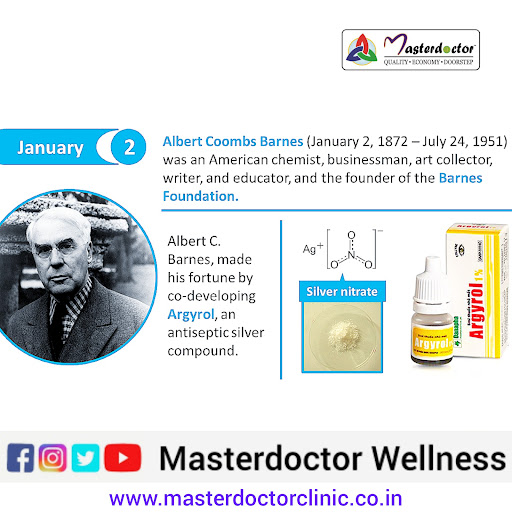
Albert Coombs Barnes was an American chemist who invented the antiseptic Argyrol (1902). This is…

Albert Coombs Barnes was an American chemist who invented the antiseptic Argyrol (1902). This is a silver-protein compound used in aqueous solution as a topical antiseptic. Believing in the social theories of philosophers such as John Dewey, Barnes felt he could better the lives of his fellow citizens. He applied his own ideas in his own factories. He scheduled his workers on 8-hour shifts 6 hours on the production line, followed by 2 hours of lectures on esthetics and art. He became a noted art collector, whose collection is now in the Barnes Foundation galleries in Merion, outside Philadelphia. Barnes' theories of art appreciation continue to be taught at the Barnes Foundation today. Dr. Barnes died in a car crash in 1951. www.drbjagadish.com
Albert Coombs Barnes was an American chemist who invented the antiseptic Argyrol (1902). This is… post imageRead full post

Indian physicist and mathematician who collaborated with Albert Einstein to develop a theory of s…

Indian physicist and mathematician who collaborated with Albert Einstein to develop a theory of statistical quantum mechanics, now called Bose-Einstein statistics. In his early work in quantum theory (1924), Bose wrote about the Planck black-body radiation law using a quantum statistics of photons, Plank's Law and the Light Quantum Hypothesis. Bose sent his ideas to Einstein, who extended this technique to integral spin particles. Dirac coined the name boson for particles obeying these statistics. Among other things, Bose-Einstein statistics explain how an electric current can flow in superconductors forever, with no loss. Bose also worked on X-ray diffraction, electrical properties of the ionosphere and thermoluminescence. www.drbjagadish.com

Indian physicist and mathematician who collaborated with Albert Einstein to develop a theory of s… post imageRead full post

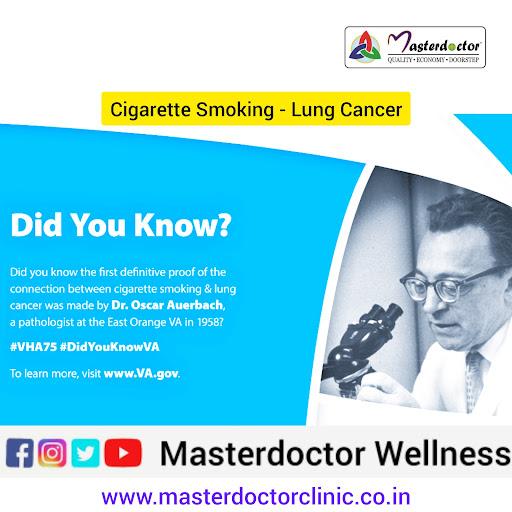
American pathologist whose diligent research produced the first evidence in human lung tissue of…

American pathologist whose diligent research produced the first evidence in human lung tissue of a causal connection between cigarette smoking and cancer. His results of microscopic examination of thousands of lung tissue slides were prominently cited in the Surgeon General's 1964 landmark report on the dangers of smoking to health. Statistical results had earlier found that the more people smoked, the greater the likelihood of cancer. Instead of statistical analysis of large groups of people, Auerbach directly demonstrated, one patient at a time, that lung tissue samples from smokers showed damage to the tissues. Furthermore, the heavier smokers had greater lung damage. He also studied the effect of passive smoking, and found that breathing in a smoky environment also showed a degree of lung damage. www.drbjagadish.com

American pathologist whose diligent research produced the first evidence in human lung tissue of… post imageRead full post

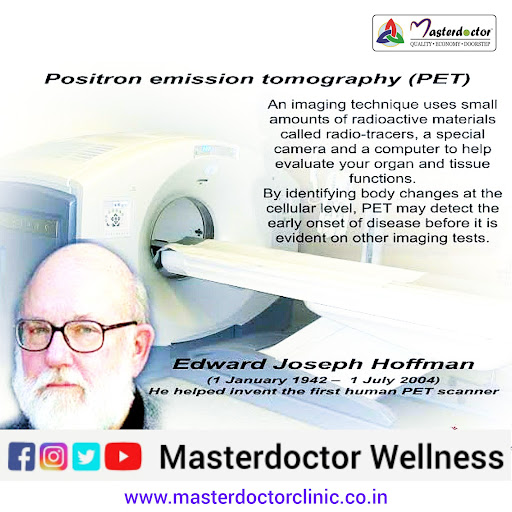
American biomedical physicist who helped create (1974) the PET Scanner (Positron Emission Tomogra…

American biomedical physicist who helped create (1974) the PET Scanner (Positron Emission Tomography), which is used to detect cancers and other diseases. Michael E Phelps and others share credit for this invention. A patient is prepared for a PET scan with an injection of slightly radioactive material, typically tagging molecules that behave like glucose within the body. Since cancerous tissues consume glucose, the scanner can then detect their location. PET technology can also be employed in the diagnosis of cardiovascular disease and Alzheimer's disease. Hoffman further developed the PET Scanner for use in making quantitative measurements. He became internationally known in the field of medical imaging. By the time he died in 2004, some 1,500 scanners were in use as a powerful diagnostic tool for saving or extending lives. www.drbjagadish.com

American biomedical physicist who helped create (1974) the PET Scanner (Positron Emission Tomogra… post imageRead full post

English physician (1st Baronet) who was prominent in his field, and a leading clinical teacher, a…

English physician (1st Baronet) who was prominent in his field, and a leading clinical teacher, at Guy’s Hospital, London, for most of his life. After he successfully treated the Prince of Wales for typhoid, he was created a baronet (1872). Queen Victoria also was one of his patients. He wrote the first description of syringomyelia (1862). The disease for which he remains known, Gull’s disease, had been described before him, but by 1874, Gull had associated myxoedema with atrophy of the thyroid gland, which he viewed as an adult form of cretinism. He coined the term Anorexia Nervosa (1874) for a “nervous loss of appetite,” known since it had been described by physician, Richard Morton (1689). He believed in minimal use of drugs, but supported the use of vivisection in research. www.drbjagadish.com

English physician (1st Baronet) who was prominent in his field, and a leading clinical teacher, a… post imageRead full post

Dutch physician, botanist and chemist, who as professor of medicine taught medical students at th…

Dutch physician, botanist and chemist, who as professor of medicine taught medical students at the sickbed. He has been called the “founder of clinical teaching” since he founded a hospital where he combined practice with clinical instruction, a method continued in modern medical education. He was the first to describe the sweat glands, and that smallpox is transmitted only by contact. Although his discoveries were few, he collated existing medical knowledge. He wrote medical textbooks popular both during and after his lifetime. In 1718, he became professor of chemistry, and published Elementa Chemiae (Elements of Chemistry, 1724), an intellegible work that eluciated the subject. He also made contributions in the field of botany. Sometimes called the “Dutch Hippocrates,” he was the most eminent physician since Galen. www.drbjagadish.com

Dutch physician, botanist and chemist, who as professor of medicine taught medical students at th… post imageRead full post

American cell biologist who shared (with James E. Rothman and Thomas C. Südhof) the 2013 Nobel Pr…

American cell biologist who shared (with James E. Rothman and Thomas C. Südhof) the 2013 Nobel Prize in Physiology or Medicine “for their discoveries of machinery regulating vesicle traffic, a major transport system in our cells.” Vesicles are tiny, sac-like structures that serve as transportation mechanisms within cells. While this fact was long known, the precise mechanism had remained unexplained as to how they fused with organelles or the plasma membrane to ferry the cargo of substances needed by the cell to various destinations within, as well as outside the cell. The problem could be imagined like looking at a fleet of vans transporting thousands of packages around hundreds of miles of city streets and needing to explain how they efficiently find the right destination where to stop and unload which parts of the cargo. www.masterdoctorclinic.co.in www.drbjagadish.com

American cell biologist who shared (with James E. Rothman and Thomas C. Südhof) the 2013 Nobel Pr… post imageRead full post